Your parts, made by factories that answer.
Send a drawing and a quantity. We pass it to the factories and print farms in our network that make that kind of part: CNC machining, sheet metal, injection moulding, PCBA, wire harness, assembly and 3D printing. You get quotes, photos of every step, and one person who follows the order to your door.
No drawing yet? Describe the product in a sentence and we design it, simulate the making and price it.
Factories in Shenzhen and Dongguan, print farms in Australia, the US, Sweden and Shenzhen. See the print network.
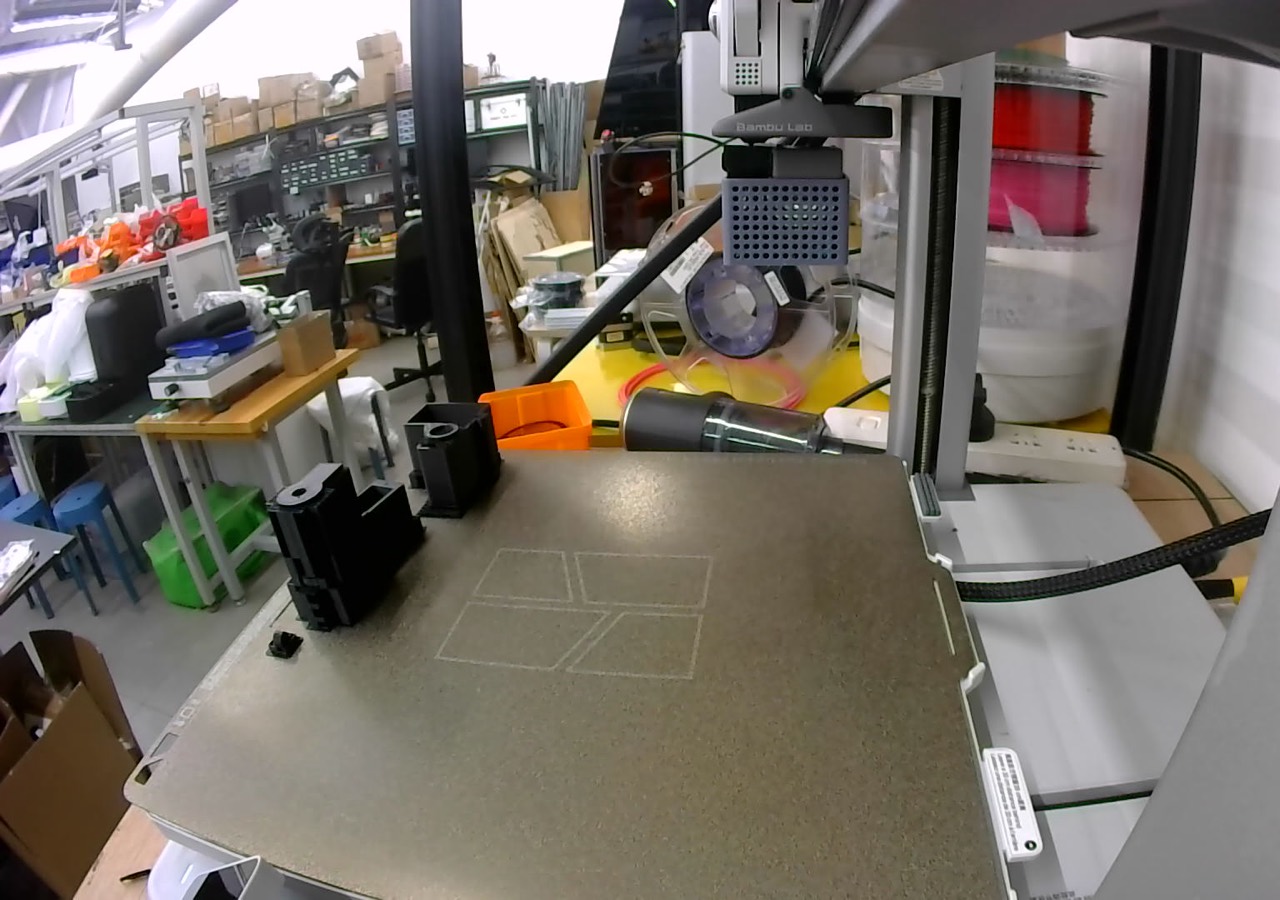
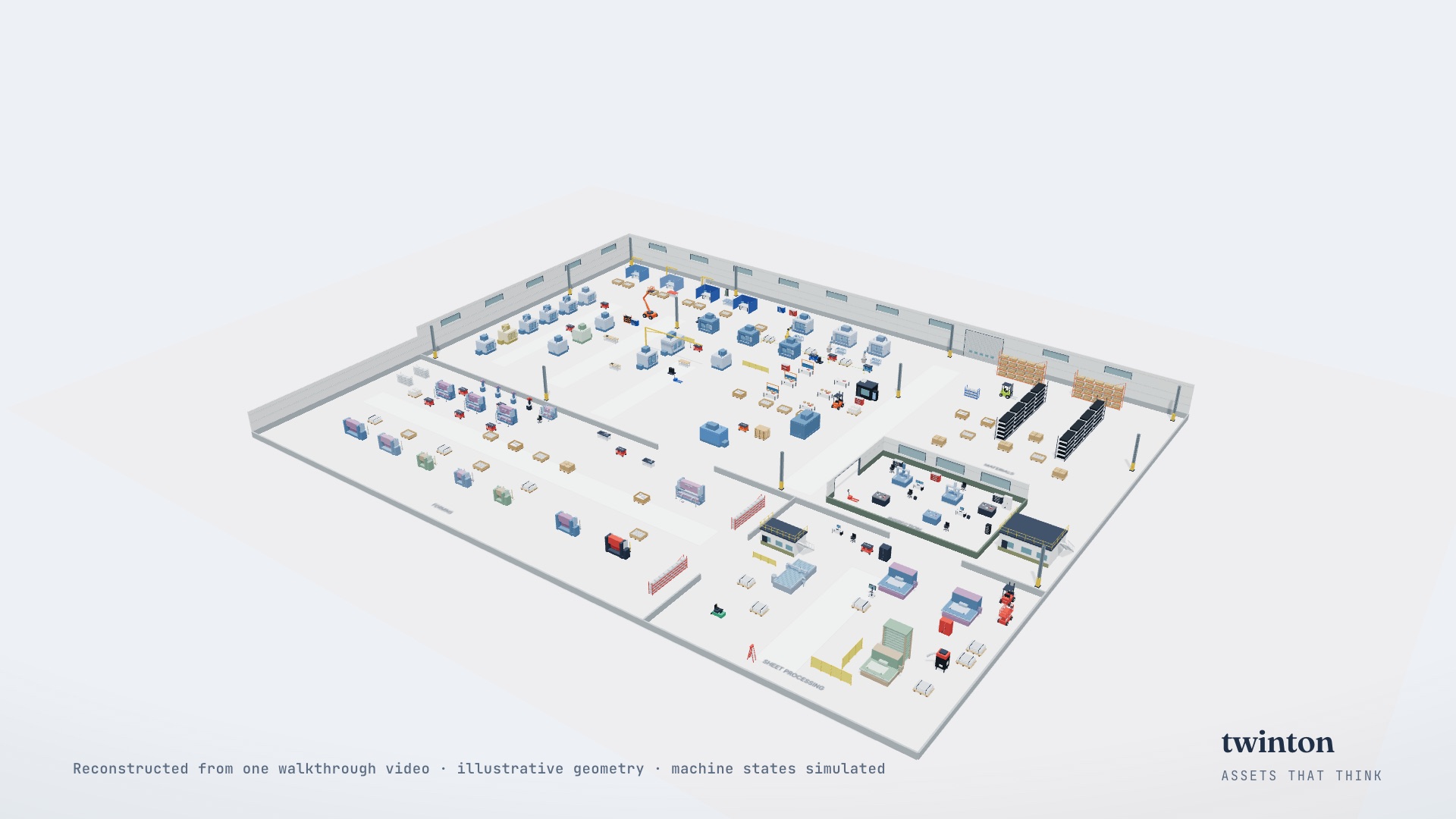
See what waits, what moves, and what leaves the building.
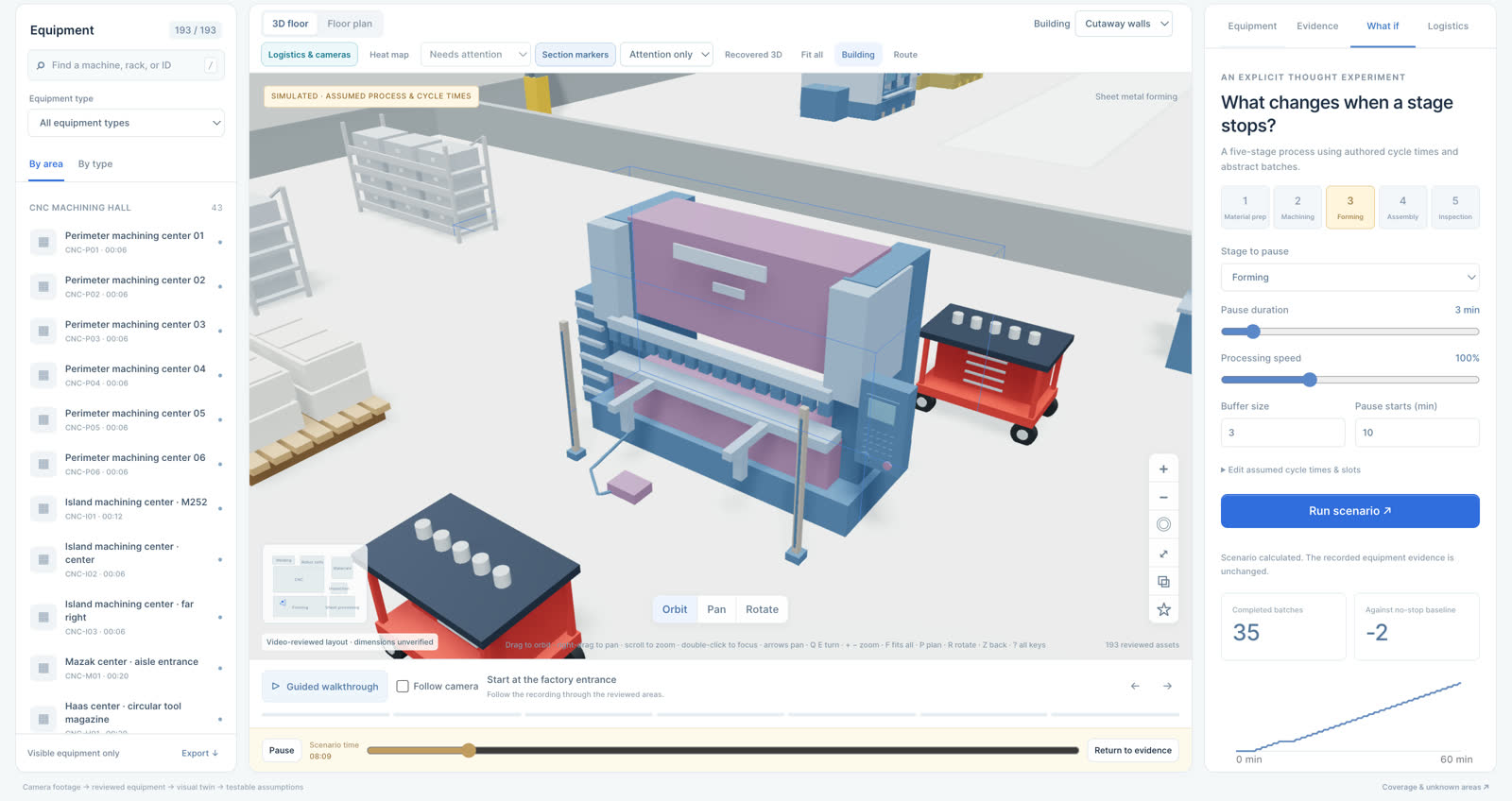
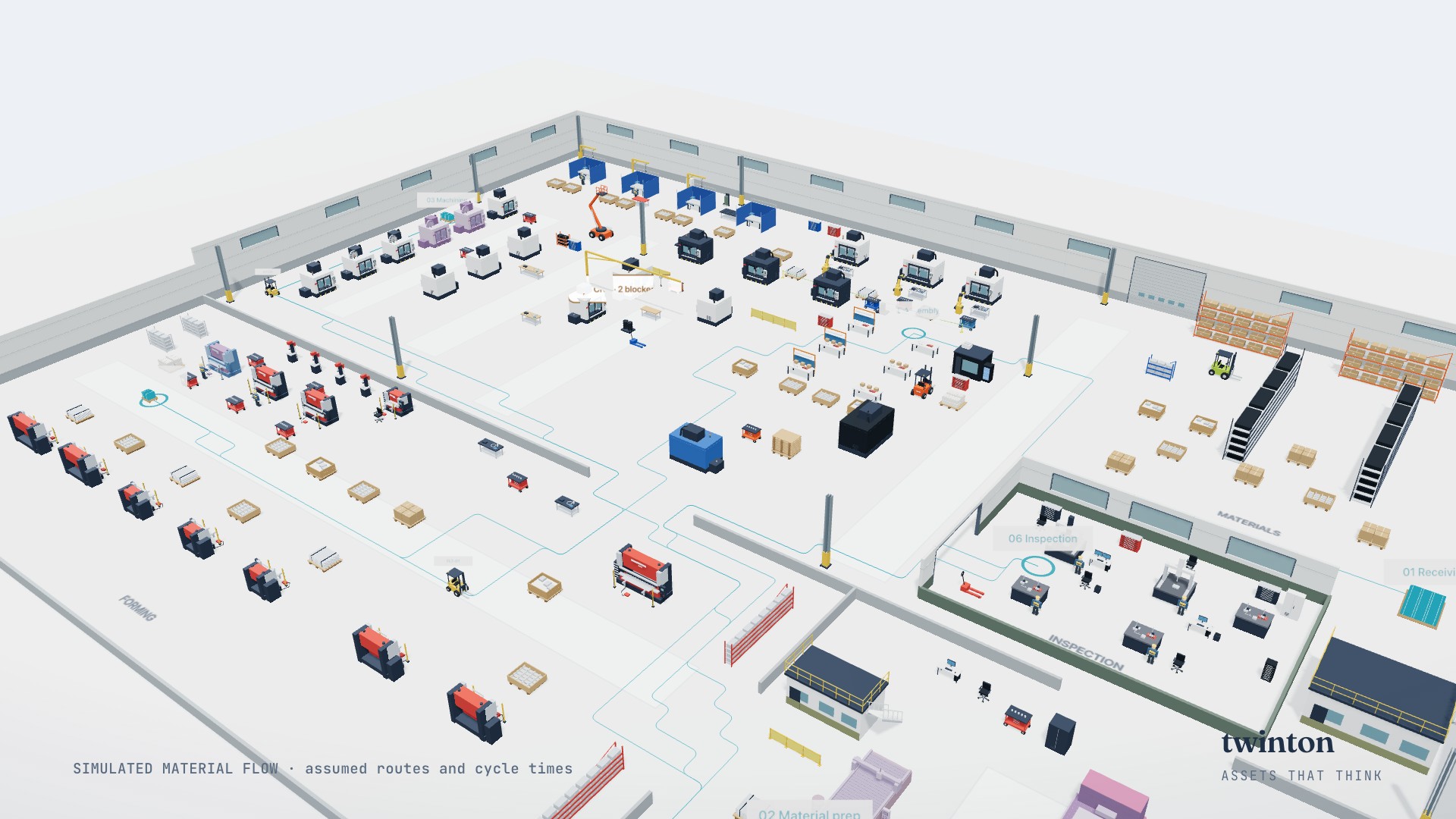
Twinton is a working model of your production area, built from a walkthrough video and connected to your floor. When an order is late it tells the plant manager which station it is waiting at and for how long, and which upstream machines went idle while it waited.
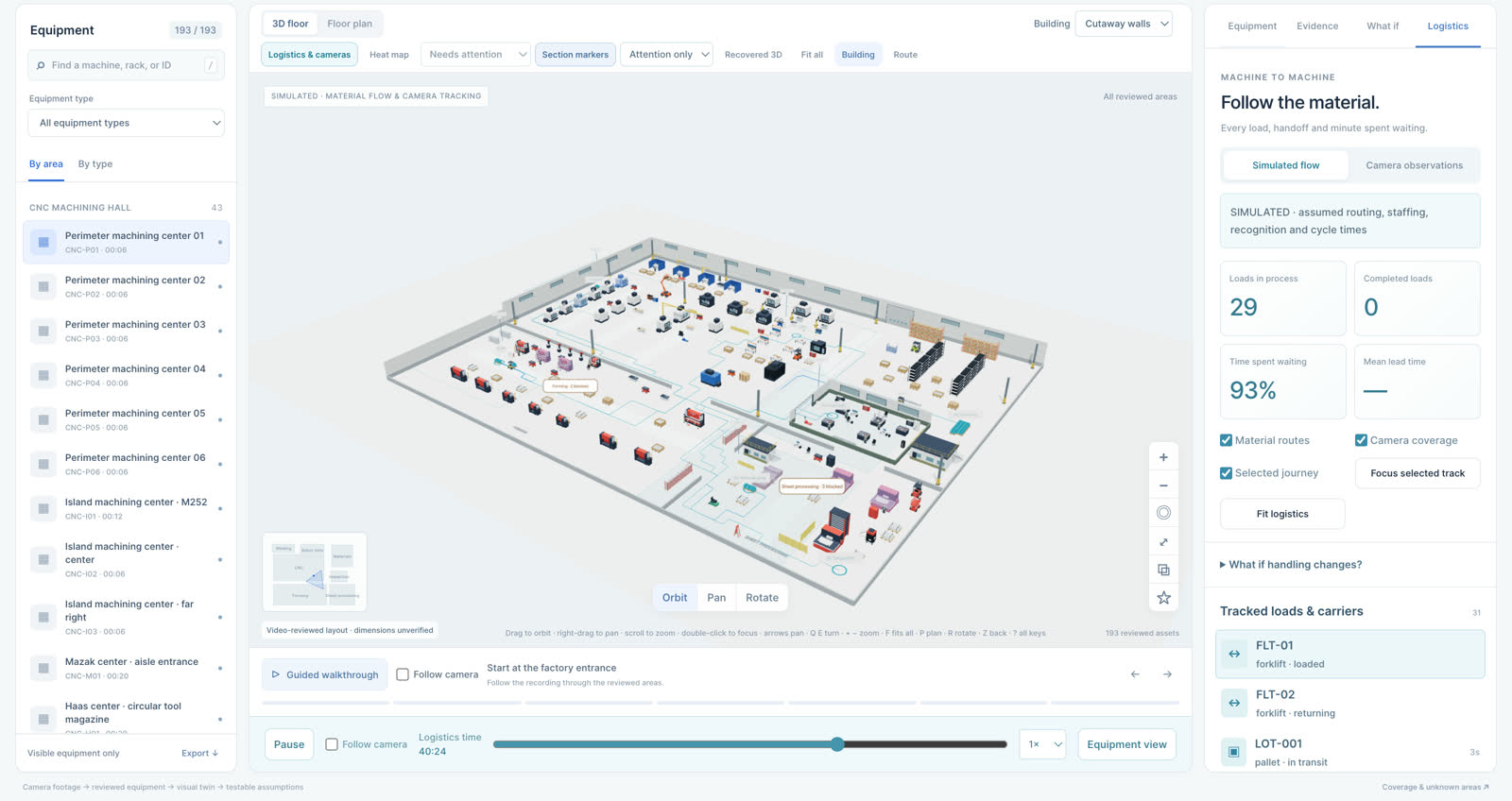
Every screen says which numbers are observed and which are simulated. Unknown stays unknown.
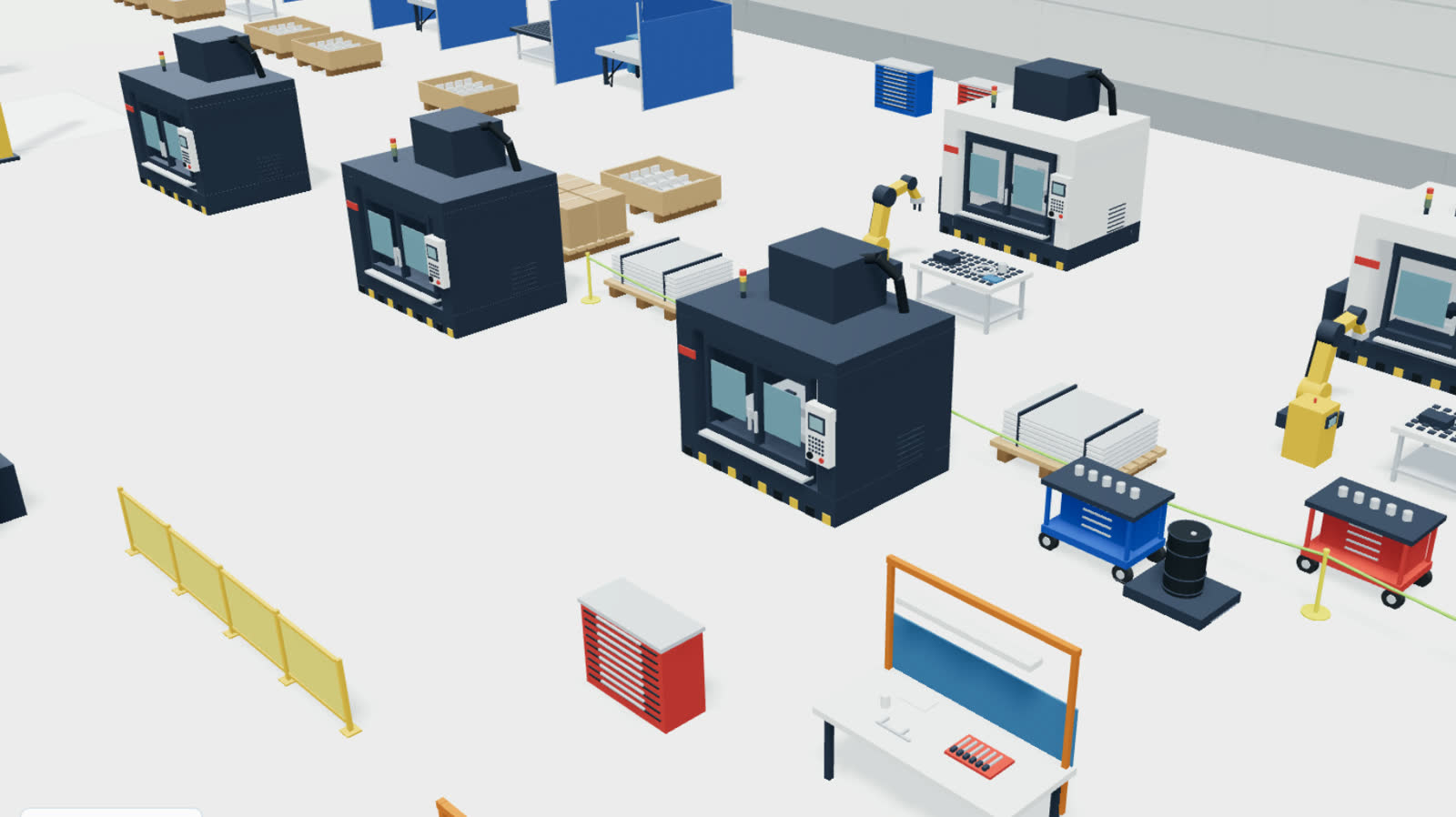
Four things it does on a real floor.
How a deployment runs.
- One area, four weeks. Five to ten workstations and one named owner on your side. The baseline, the technical review and the decision date are agreed before anything is installed.
- Our engineer on your floor in Shenzhen. Six on-site days in the founding pilot. The walkthrough, the camera and scanner placement, and the event definitions happen with your supervisor in the room.
- Your inputs, not new ones. Cameras you already have, a barcode scan, a tablet, a button on the bench. Whichever tells us a handoff happened most reliably.
- A written before and after. Reliability, adoption, interventions, costs and unresolved causes. The pilot fee is credited against year one if you continue.
Chinese-language materials and on-site interpretation are part of every pilot. 每次试点都包含中文资料和现场翻译。
The edge of the building is next.
Trucks at the gate, docks, what came in against which order and revision, what left today and whether anyone logged it. The gate and logistics model is in design this week and joins the floor twin as a second area type.
Your customers' agents, on one wire
The factory agent network carries quotes, orders, change notices, shipments and gate events as signed messages both sides can read. A quote without a price, a currency, a lead time and a validity date is refused by the wire itself.
CE Compute · built on ce-net
The same infrastructure.
A new use for compute.
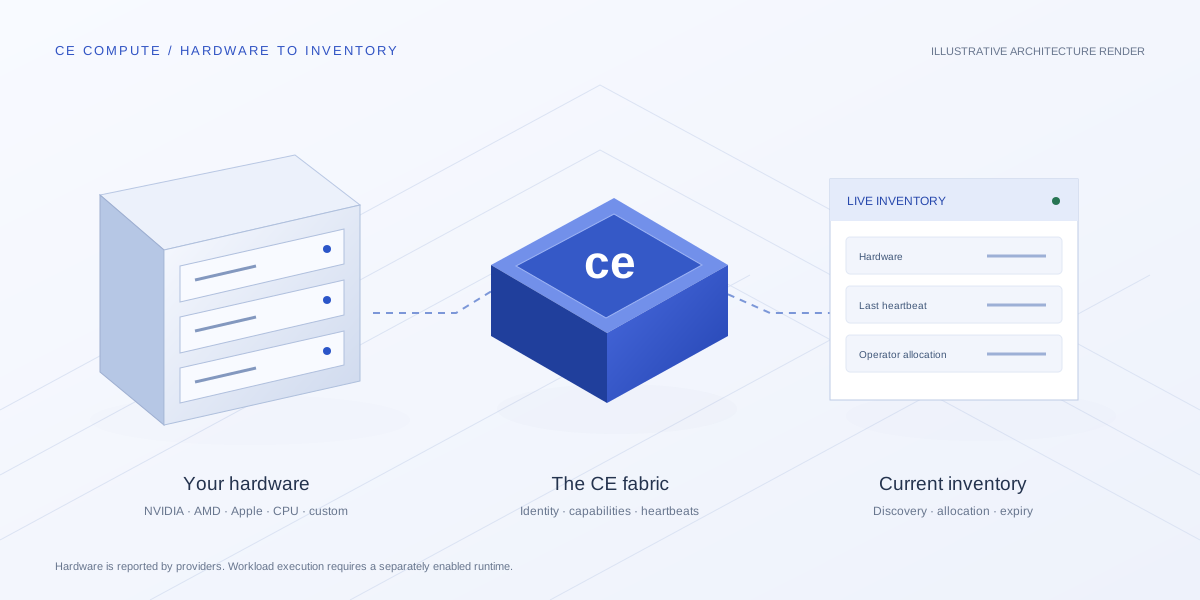
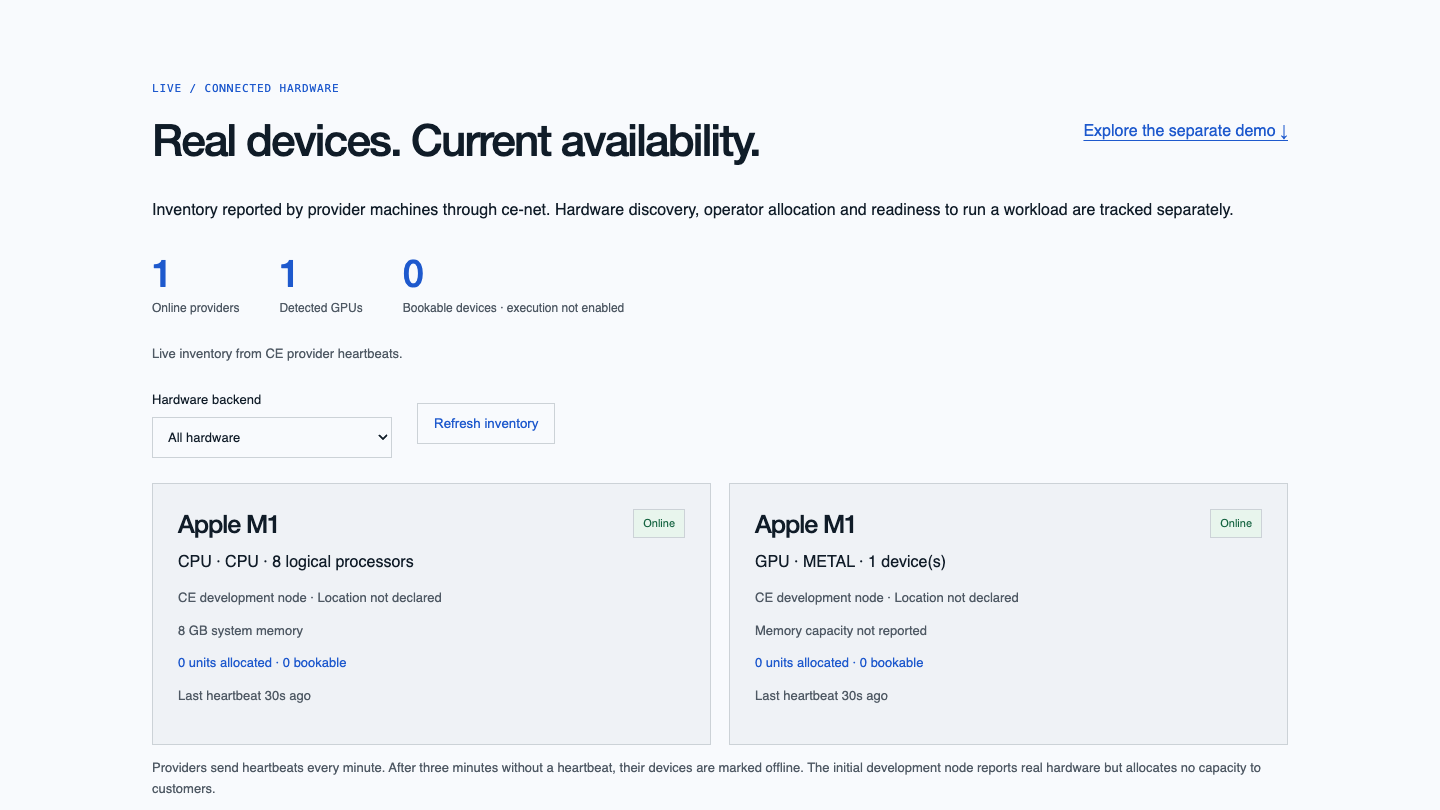
CE Compute connects hardware providers to a live inventory through the CE network. Discover GPUs and CPUs, see the last heartbeat, and distinguish detected hardware from capacity an operator has allocated.
Built for different machines.
NVIDIA, AMD, Apple Silicon and CPU hosts use a common provider interface. Custom adapters can report other accelerators. The initial development node reports real hardware; customer workload execution is not enabled.
From availability to a marketplace.
The marketplace pilot adds capacity offers, residency policies, reservations and usage accounting. Explore the separate synthetic demo to see a quote and the 10% platform fee.
Hardware · built on ce-net
Sensors that report through the devices already there.
Any computer or phone running ce-net can carry a reading from a tag nearby. Use cases in factories, logistics, transportation and streets.
CE Engineering
From a sketch to a working cell.
We design the part, print it on our farm in Shenzhen, and set up the robot cell that handles it. Every move runs in the twin first, then on the real arm. An engineering sprint is EUR 690: one product or subassembly in two weeks, prototype shipped.
Paid work running now: a robot-arm disassembly line, LED frame engineering, the Huey walking robot and custom SSD hardware, built in our Shenzhen workshop.

Who builds it
Leif Adamec Rydenfalk, founder.
I'm a self-taught systems engineer from Umeå, Sweden, and I build ce-net from Shenzhen. Every demo on this site runs on it. Write to me and you get an answer from me.
Bring one late order. We show you where it waited.
Thirty minutes on a call, then a walk of one area of your floor with the twin on a laptop. No preparation needed.