Let’s build a global supercomputer, for science.
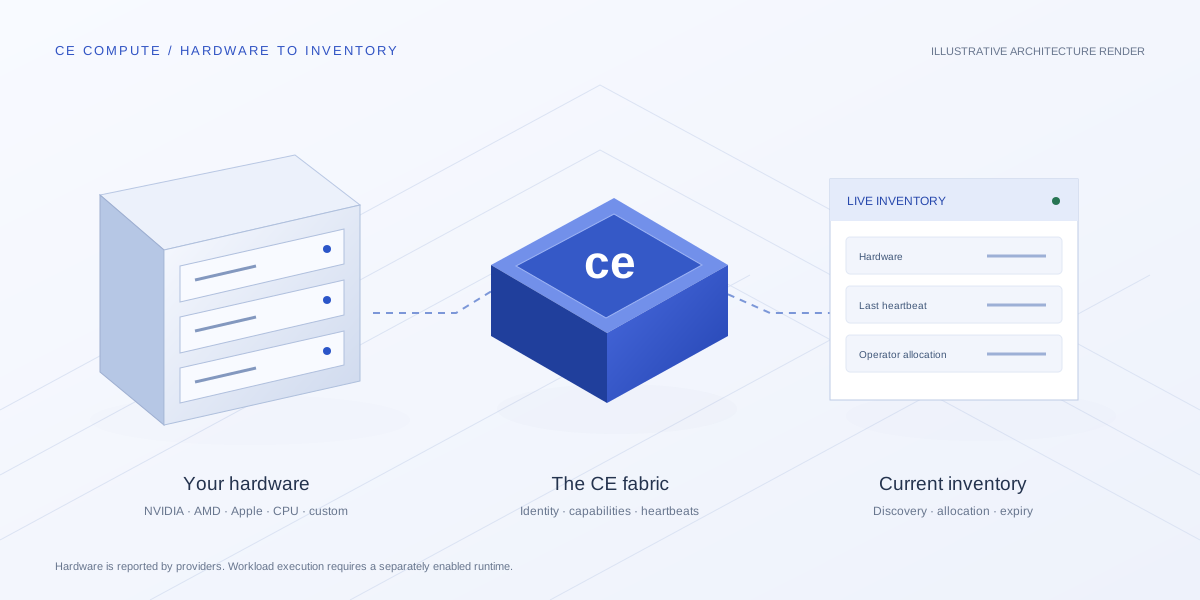
Every idle phone, laptop, and GPU, pooled into one machine that belongs to everyone. Open this page on any device and it becomes a node — running tasks for the mesh in seconds, no install. The goal: fold proteins, train AI, and search the sky — on compute that belongs to everyone.
No install, no account, no sign-up. Works on any phone or laptop — the page joins the mesh and starts running tasks on this device.
A planetary instrument for science.
The hardest problems are compute problems. Pool the world's idle phones, laptops, and GPUs and you get a machine large enough to point at them — folding proteins, training models, reading the sky. Every job runs in a sandbox and settles in credits, so the same network that runs a lab in Nairobi runs a student's notebook in São Paulo. Compute stops being a budget line and becomes a commons.
AI & machine learning
Train, fine-tune, and serve models across donated GPUs. Distributed training, batch inference, and retrieval — run any model on compute you don't have to own.
Protein folding & drug discovery
The original volunteer-science workload, at network scale. Fold structures, run molecular dynamics, and screen millions of drug candidates in parallel.
Satellite & Earth observation
Turn petabytes of orbital imagery into answers — deforestation, wildfire spread, floods, crop health, glacier retreat — processed close to whoever needs them.
Exoplanets & astronomy
Sift telescope light curves for the dip of a passing world, fold pulsar timing, and comb radio data for technosignatures across thousands of cores.
Climate & physics simulation
Run climate ensembles, ocean and fluid dynamics, Monte Carlo and lattice models — the embarrassingly parallel core of modern physical science.
Genomics & bioinformatics
Align genomes, assemble sequences, and call variants at population scale — pipeline a whole cohort across the mesh instead of queueing for a cluster.
A computer that runs computers
Every job is a sandboxed Docker container or fuel-metered WASM. Boot a whole operating system, a CI runner, a render farm, or a headless browser — on someone else's idle core, safely.
…your workload
If it's parallel, it runs here. Bring a container, bid credits, and the network finds the hosts, escrows the job, and settles when the work comes back.
Five primitives. One self-organizing network.
CE is primitives, not a product. Every node ships the same small, hard core — and everything else is an app built on top of it. No new node endpoints per app, no product semantics baked into consensus. The core stays small on purpose.
Identity
An Ed25519 keypair is the node — a 32-byte public key. No registration: sign and be verified.
Mesh
libp2p — Kademlia, gossipsub, QUIC, circuit relay and DCUtR hole-punching. Devices reach each other directly; IPs are never stored.
Ledger
A proof-of-work chain mints credits and escrows jobs. Money is integer base units — 1018 per credit — never floats.
Capabilities
Authorization is a signed, attenuating chain — delegate a subset, narrow it, revoke it. CE's only trust primitive.
Compute
Sandboxed Docker (gVisor) and fuel-metered WASM. Billed by the second.
One command installs anything, anywhere on your mesh. Working
ce app is the one way to install, run, and supervise anything on CE — a mesh-native
app, a legacy system like Postgres or ffmpeg, or a whole stack. Describe it in a small manifest; CE resolves
the runtime, fetches content-addressed artifacts, mints a capability for exactly the permissions it declared,
and runs it in a sandbox. Same command on your laptop, the relay, or every paired device at once.
Any app as an OCI image, content-addressed and gVisor-sandboxed.
legacy systems — Postgres, ffmpegA prebuilt per-platform binary, resolved by (os, arch).
mesh apps that need host accessOne portable module for every platform, fuel- and memory-capped.
strongest isolation, write onceGit source plus build commands, compiled and cached as an artifact.
build-from-source fallback[app]
name = "postgres"
version = "16.0.0"
runtime = "oci"
[oci]
image = "docker.io/library/postgres:16"
ports = ["5432"]
[sandbox]
tier = "gvisor" # gvisor | runc | wasm | none
net = "loopback" # mesh-only | loopback | egress | none
[deps]
capabilities = ["exec", "sync"] # exactly what it may usece app install postgres # resolve, fetch, sandbox
ce app install rdev --on fleet=mine # every paired device
ce app run ffmpeg -- -i in.mp4 out.webm # one-shot sandbox
ce app ps # live instances, whole meshOne edge. Every backend is on the mesh. Live
Ask for ce-net.com and a single public HTTP tier resolves the host to a content-addressed bundle over the mesh, fetches the files by their content id, and serves them — with a bridge injected so the page itself becomes a node. There is no app server to run: state lives on the mesh as content-addressed blobs and gossipsub events.
ce-serve
The one public ingress. It resolves the requested host through ce-hub over the mesh — ce-hub hosts nothing, it only tracks.
Fetch the bundle
Files are addressed by hash, so a redeploy makes new ids — browsers never re-download unchanged bytes, and popular assets self-replicate across the mesh.
The mesh bridge
Each page gets a small script that opens a /mesh-bridge socket — publish, subscribe, request, blobs, discovery. Money and admin routes are never exposed.
ce app install ce-serve.No passwords. No logins. Your node is your identity.
When an app needs to know who you are, your local node mints a scoped, expiring capability for that exact action — nothing typed, nothing pasted, no secret crosses the screen. The app verifies it offline, in microseconds, with no callback to any server.
A signed, attenuating chain
An owner signs a grant delegating a subset of their power — these abilities, on these resources, until this time. Whoever holds it can sub-delegate, but only a strict subset. No link can ever widen what it was given, and a node accepts any chain that roots in a key it trusts — checked locally, no policy server.
# on the machine that owns the resource
ce grant <node-id> --can exec,sync,tunnel \
--ports 22 --expires 90d
# → a signed capability. the holder stores it; the
# owner accepts it because the chain roots at the
# owner's own key. no device list, no machines.toml.Live ce-iam is CE's identity, access, and secrets system — modeled on AWS IAM but built on capabilities: principals are NodeIds, policies mint grants, “assume role” is attenuation. Minting lives only on the node; the browser can verify and hold secrets but never mint authority. The end-to-end “verify on any website via your node” flow is In development — that's the direction we're building toward.
Donate compute. Earn credits. Spend them anywhere.
Run a node
One binary joins the mesh and starts mining. Blocks land every ~10 seconds and pay an uptime reward — just for keeping the lights on.
Earn & offer
Credits accrue to your key. Offer your CPU or GPU; the chain escrows each job and settles to you when the work is delivered.
Spend on compute
Bid credits to run a container on a machine you’ve never met. Redundant runs and on-chain history let you verify the host.
An SDK that’s layers, not a monolith.
Point a typed client at your local node and build — in Rust or TypeScript. @ce-net/sdk is live on npm; ce-rs is the Rust core; ce-coord adds coordination on top: typed streams and replicated state. Same surface, fully decoupled — add only what you need.
In your browser, too
npm i @ce-net/sdk — a typed, runtime-agnostic client for Node, Deno, Bun, browsers, and edge Workers. Money is bigint base units; streams are typed async iterables.
Talk to the network
Find a host, deploy a container, move credits — all over the mesh, all typed.
ce-coord · optionalCoordinate state
Typed pub/sub streams and replicated collections, built on CE primitives — not baked into the node.
let ce = CeClient::local();
let host = ce.atlas().await?
.into_iter().find(|h| h.has_tag("gpu"))?;
// deploy a container on a peer, paid in credits
ce.mesh_deploy(&host.node_id, &spec, None).await?;// same client — coordination is purely additive
let coord = Coord::with_client(ce.clone()).await?;
let map = coord.map_writer::<String,i64>("balances").await?;
map.insert("alice".into(), 100).await?; // replicatedGoogle infrastructure, rebuilt on the mesh.
Dozens of real, tested repos composing the same primitives — no node forks. Each is a managed-cloud service you already know, with the control plane and the middleman removed. Every one below is built and tested.
A workspace, and apps people use.
CE Drive
Distributed FS + open-source Google Drive — move-CRDT tree, capability-shared, FUSE-mountable.
CE Notes
Local-first, end-to-end-encrypted CRDT notes across all your devices.
CE Board
Real-time kanban that converges across tabs over the mesh.
CE Chat
Team chat over mesh pub/sub — channels, presence, private rooms.
CE Meet
WebRTC calls signaled over mesh pub/sub — rooms, roster, capability admission.
CE Mail
Identity-native E2E email — your address is your NodeId; sealed blobs.
CE Explorer
Watch the network breathe — live blocks, jobs, the share-ratio board.
CE Paste
A content-addressed pastebin where the CID is the URL.
…and more
Query, Cache, CI, Render, Host, Fleet, Sched, Bench. Browse them all.
Credits run the mesh. Real money runs your business.
CE settles compute internally in credits — earned by hosting, spent by running. The next layer will bridge that to real revenue: charge customers in fiat, and a payment will turn directly into a capability that unlocks your service. No license server, no per-request check-in.
Fiat, any rail
A customer pays through Stripe, Paddle, or crypto. The money rail stays a conventional, trusted third party — deliberately.
Payment becomes a capability
The webhook hits a ce-pay mesh service, which mints a scoped, time-bounded, revocable capability and delivers it sealed to the customer's node.
Verified offline
“Subscription active” simply means “holds a valid capability.” A lapse expires it; a refund revokes it on-chain, instantly.
Designed An owner-signed design, not yet a shipped feature — you can't charge customers through CE today. Fiat is what your customers pay you; credits are what your app spends to run on the mesh; your margin is the difference.
One binary. Every platform.
No daemon zoo, no Kubernetes. Install the node and run ce start — or npm i @ce-net/sdk to build on it.
npm i @ce-net/sdkcurl -sSL https://ce-net.com/install.sh | bashcargo build --releasebrew install ce-net/ce/cescoop install ceCompute should be a commons, not a cartel.
Spin up a node and the network does the rest — discovery, consensus, settlement, and trust, all without a middleman.